Drug trials claim over 2,000 lives in four years
In the last four years, 2,031 people died in India as a result of
Serious Adverse Events (SAEs) caused during drug trials but only about 1
per cent cases received any compensation, information disclosed by the
office of the Drug Controller-General of India has revealed.
The figures of SAE-related deaths for 2008, 2009, 2010 and 2011 are 288,
637, 668 and 438. However, compensation was provided only in 22 cases
of deaths and that too only in 2010, according to information available
with the DCG (I).
No compensation was paid for 2008 and 2009 and the data for 2011 has yet to be compiled.
The information was provided by the DCG (I) in response to a Right to
Information query filed by Indore-based medical rights activist Anand
Rai.
The reason for such a small number of cases receiving compensation is
simple: Pharma companies conducting clinical trials pay compensation
only in cases where it is established that the death was caused as a
result of the trials and not merely during the trial.
“But it is the companies themselves that decide whether a death was
caused due to the trials or not. So there is a conflict of interest
there as the companies want to pay compensation in the lowest possible
number of cases,” says Dr. Rai, who founded the Clinical Trial Victim
Association of Madhya Pradesh.
“We believe all cases of SAE-related deaths should receive compensation.
We have filed a petition in the Supreme Court on the matter,” says Dr.
Rai.
Dr. Rai also asked for the SAE-related death figures for the year 2012
and for details of the trial sites/hospitals where the 2,031 deaths
occurred and their State-wise location, but the DCG (I) said it did not
maintain such data.
However, on an appeal by the petitioner, the CIC on Friday directed the
DCG (I) to provide the State-wise trial site details by August 15, 2012.
The CIC also directed the DCG(I) to provide the petitioner with figures
for SAE-related deaths till January 2012. The DCG(I) told the Commission
the data up to January 2012 had not been compiled as it was compiled
four to six months after the end of the calendar years.
On this, Information Commissioner Shailesh Gandhi said data should be available on a monthly basis.
“The Commission feels such data should be available every month,” Mr. Gandhi noted in the order, passed on Friday.
Source: http://www.thehindu.com/health/policy-and-issues/article3589099.ece
Indians sitting ducks as drug trials turn fatal
In last 4 yrs, 1,725 persons have died in clinical trials; weak law compounds risks
Aditi Tandon/TNS
Tribune News Service
New Delhi, August 7
For the first time since 2010 when six tribal girls from Gujarat and Andhra Pradesh involved in the clinical trials of anti-cervical cancer HPV vaccine died, the government has admitted that 1,725 persons have lost their lives to drug trials in the last four years.
The number of deaths has risen from 132 in 2007 and 288 in 2008 to 637 in 2009 and 668 last year, indicating the complete ineffectiveness of regulatory controls over the $400 million sector. Last year, the government gave compensation in just 22 cases out of the 668 that resulted in deaths due to “serious adverse events” during drug trials, Health Minister Ghulam Nabi Azad told Parliament this week.
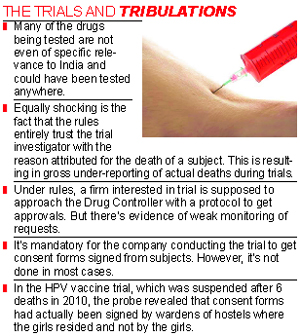 Currently, 1,868 clinical trials are going on as per the Clinical Trial Registry of India maintained by the office of the Drug Controller General of India (DCGI). Many of the drugs being tested are not even of specific relevance to the country and could have been tested anywhere. Equally shocking is the fact that the rules, under the Drugs and Cosmetics Act, entirely trust the trial investigator with the reason attributed for the death of a subject. This is resulting in gross under-reporting of actual deaths during clinical trials.
Dr Chandra Gulhati, a leading medical practitioner, who led several clinical trials in the UK, says the number of deaths would be much more than we will ever know. “We have no system of independent auditors to investigate the cause of death of subjects involved in clinical trials. Whatever the investigator says is believed even if he attributes the death to a prior disease. Such investigators are always hired by the firm conducting the trial. How can we expect them to be objective all the time?”, he asks.
Under the rules, a company interested in trial is supposed to approach the Drug Controller with a protocol to get approvals. But there has been evidence of weak monitoring of requests. “I just investigated a case where 800 pages of protocol were submitted to the DCGI for approval. The permission was granted in four days whereas even a clinician like me would require at least a month to understand the whole project. Clearly, people in the DCGI office are not vetting the requests properly,” said Gulhati, who is now investigating the cause of 81 deaths due to recent clinical trials in Indore.
The rules further mandate the company conducting the trial to get consent forms signed from subjects. The idea is to have safeguards but it’s not working. In the HPV vaccine trial which was suspended after 6 deaths last year, the government inquiry concluded that consent forms had actually been signed by wardens of hostels where the girls resided and not by the girls themselves. In both Gujarat and Andhra, over 22 pc of the vaccinated girls were tribals even though our law bar trials on tribals unless the drug being tested is of specific benefit to them.
Dr Amit Sengupta, who helped expose loopholes in the HPV trial conducted by the US NGO PATH, says India must drastically reduce the number of trials happening here. “Why should we allow trials of drugs for medical conditions that prevail elsewhere in the world? Trials for diarrhoea, malaria etc are understandable, but why should foreign firms come to us to test anti-cancer drugs? Cancer is prevalent in their countries also. Let them test there,” he says. The reason is: since the cost of testing in India is 80 per cent less than in the developed world, firms come here. Experts, meanwhile, also want the DCGI to frame rules to specify that trials will be allowed only in cases where the firm in question undertakes to make the drug available to Indians at affordable prices.
Promoters of the HPV vaccine trial for instance wanted the vaccine included under India’s Universal Immunisation Programme even though it costs Rs 9000 per eligible girl (age 9 to 15 years). Vaccines for trial came free of cost from pharma giants GSK and MSD. Considering 1.25 crore girls enter the age group 9 to 15 years annually, the promoters could have made Rs 11, 250 crore per year had the government accepted public distribution of the HPV vaccine.
Source: http://www.tribuneindia.com/2011/20110808/main1.htm
NHRC issues notices to the Union Health Secretary, ICMR and DCGI calling for reports on allegations of fatal drug trials in the country
New Delhi, August 12th, 2011
The National Human Rights Commission, NHRC, has taken suo motu cognizance of a media report alleging that 1,725 persons have lost their lives to drug trials in the last four years in the country which indicate complete ineffectiveness of regulatory controls over the $400 million sector.
It is alleged in the report that many of the drugs being tested are not even of specific relevance to the country and could have been tested anywhere. Equally shocking is the fact that the rules, under the Drugs and Cosmetics Act, entirely trust the trial investigator with the reason attributed for the death of a subject. This is resulting in gross under reporting of actual deaths during clinical trials.
Allegedly, there has been evidence of weak monitoring of requests of the companies approaching the Drug Controller with a protocol to get approval for drug trials as per rules. Reportedly at present 1,868 clinical trials are going on as per the official records of the Drug Controller General of India.
The Commission has observed under the case no. 787/6/0/2011 that if the contents of media report are true then these raise a serious issue of violations of human rights of the drug trial victims, who are put to drug trials in India either without their consent or with the consent but without understanding its complications.
Notices have been issued to the Secretary (Health), Government of India, Secretary, Indian Council of Medical Research (ICMR) and the Drug Controller General of India to submit their comments in the matter within four weeks.
They are also directed to inform the Commission :
" What are the guidelines and regulations in place for conducting drug trials and for setting up Ethics Committees in hospitals to ensure patients safety?
" What are the guidelines to be followed by Ethics Committees for approving drug trials after a proposal is cleared by the Drug Controller General of India?
" What are the safeguards for ensuring that the Ethics Committees function properly?
" Whether the infrastructure in the office of the Drug Controller General of India is sufficient to cope-up with the applications for approval of drug trials in India?
" What studies have been undertaken by the authorities to find out the reasons and lapses, if any, in case of deaths of persons in various States of India during drug trials?
" Whether there is any uniform policy for compensating the victims or the next of kin of the deceased, who die during drug trials - whether authorised or unauthorised.
" What is the policy of the Government of India with regard to the nature of drugs being tested in the country keeping in view the fact that many of the drugs may be tested elsewhere?
A notice has also been sent to the Centre for Studies in Ethics and Rights, Anusandhan Trust, Mumbai seeking its comments within four weeks on the subject.
The Commission has also decided to take up the case of six women, who allegedly became victims of an unauthorised drug trials in Andhra Pradesh and the reports received from the concerned authorities their report along with this case before the Full Commission.
